Wednesday

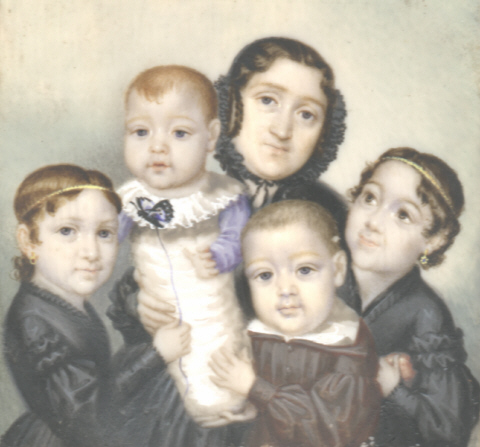
Unknown - portrait of a Italian family

This miniature is unsigned. Initially it was thought to be French or perhaps Spanish in style and probably painted around 1820. However, it is now thought to be Italian.

The frame is not shown here, but is perhaps the most expensive wooden frame in the collection. It is extremely well made of veneered and inlaid rosewood. The veneering even covers the complete rear of the portrait. At each corner of the rear, there are "butterfly" dowels to hold it together.

As the portrait is of five family members it would have been expensive when it was painted. Miniature painters often doubled their standard price when there were two sitters in a portrait, and here we have five.

The girl on the left is holding a string tied to a butterfly, which can be seen silhouetted against the baby's collar.

More recently, I have become aware that there is a miniature shown here and painted by the Italian artist Giambattista Gigola in 1807, which is in the collection of the Museo Poldi Pezzoli of Milan, Italy.

The pose and style is completely different, so there is no real similarity, except that miniature also features four children, one of who is also holding a butterfly on a string. Later copies of the Gigola miniature show the butterfly replaced by a string of pearls, so it seems there may have been a reaction against the practice.

Nevertheless, these are the only instances I am aware of where a child has a butterfly on a string and hence that makes them unusual. Thus it seems probable the miniature shown here is Italian in origin, rather than French or Spanish. 1182

Unknown - portrait of Emperor Franz Joseph


Although the artist is unknown, the portrait is of Emperor Franz Joseph of Austria (1830-1916). For more about him see Franz Joseph I of Austria - Wikipedia, the free encyclopedia 1165

Karmanski, Ignaz - portrait of a lady

This miniature portrait is signed in gold letters "Ig Karmanski 1831" for Ignaz von Karmanski an Austrian artist who was active in Vienna 1830-1832. He was trained at the Vienna Academy.

Schidlof was obvioulsy not impressed with his work as he comments "Rather mediocre artist"!

The sitter is unknown. 1164

Thursday

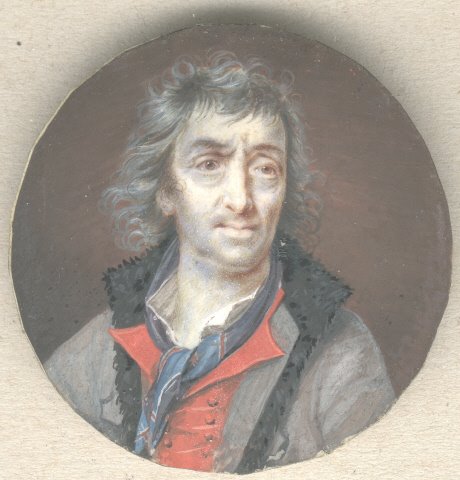
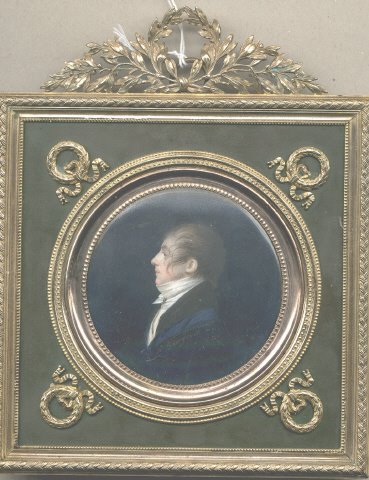
Bouchardy - portrait of a man

This miniature portrait is signed "Bouchardy", probably for the artist of that name who was active in Paris from 1770-1799. He was noted at the time for his use of the physionotrace, see Precursors of photography: Early Visual Media - Physionotrace ... He may have also been the father of the better known artist Etienne Bouchardy (1797-1849).
The sitter is unknown, but it is interesting that he was demonstrating his loyalty to the revolution by wearing a tricolor neck scarf.
Elsewhere in the collection there is a miniature portrait by Marie Noireterre of a man wearing a similar tricolor scarf which was painted around the same time. 1145

Monday

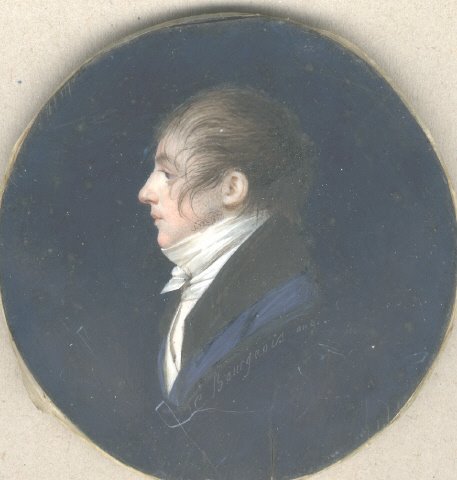
Bourgeois, Charles - portrait of unknown man


Painted in 1801 is this miniature portrait signed "C Bourgeios an 9", for Charles Guillaume Alexandre Bourgeois (1759-1832). The wording "an 9" refers to year 9 of the Revolutionary Calendar that was used in France from 1793 to 1804. Thus this miniature was painted in 1801. There are several miniatures in this style by Bourgeois in the Louvre.
For more about him see Charles Guillaume Alexandre Bourgeois - Wikipedia, the free ... 1154

Unknown - portrait of a lady


This miniature portrait is signed and dated 1810, but so far the signature has not been deciphered. The sitter is unknown, but it seems to be either a copy of a 17C portrait, or perhaps a 19C nun. 952

Friday

Soiron, Jean Francois - portrait of Joseph Chinard

This miniature portrait on enamel is by Jean Francois Soiron (1756-1813) a Swiss artist who worked in Paris and was noted for his enamel portraits.

It is set into the top of a green lacquer snuff box with gold inlay (apologies for the scanner glare) and the miniature itself is only 43mm in diameter.

The counter enamel is inscribed "Chinard celebre sculpteur membre de l'Institut National de France, & de l'Athenee de Lyon. Peint en Paris par son ami Soiron de Geneva Van 1801 an 9". (Chinard, celebrated sculptor and member of the National Institute of France and the Athenum of Lyon. Painted in Paris by his good friend Soiron of Geneva in 1801, year 9).

Dating of the miniature is interesting as it is dated in both the normal calendar as 1801, and also in the French Revolutionary Calendar which commenced in 1792, thus "an 9" was 1801.

The Bourgeois miniature in this collection is also dated "an 9".

Enamel miniatures by Soiron are rare, but for another example of a miniature by him see Jean François Soiron - Museum Briner und Kern

Joseph Chinard (1756-1813) was a famous French sculptor. This miniature is believed to be the only contemporary portrait of Chinard and hence is an important historical item.

The Frick Museum describes Chinard as one of the greatest portraitists of 18C and early 19C France, see ARCHIVED PRESS RELEASE from THE FRICK COLLECTION

Acquired subsequently for this collection, was this medal of Joseph Chinard by Torcheux.

The obverse and reverse views of the medal are shown here with the obverse depicting Joseph Chinard.

The reverse depicts Chinard's famous sculpture of the Empress Josephine which is in La Malmaison.
The medal is 67mm in diameter and is signed "A H Torcheux", for Andre-Henri Torcheux (1912-?) who is shown in the photo.

Torcheux seems to have made a number of medals commemorating various prominent French citizens from the 19C and 20C.

At present the actual date and the reason for striking this medal is unknown.

A bust of the Empress Josephine was sculpted in Milan in 1805 when she accompanied Napoleon to that city for his coronation as the King of Italy.

A slightly different terracotta version, with shoulder ruffs on the dress, is currently housed in the collection of the Cleveland Museum of Art in Ohio.

For more about Chinard, including details of his works in the Getty Museum see Joseph Chinard (Getty Museum)

Also shown here is another miniature portrait by Jean-Francois Soiron. This one of Napoleon was displayed in an exhibition at Somerset House entitled 'France in Russia : Empress Josephine's Malmaison Collection' which ran from 25 July to 4 November 2007.

The exhibition explored the history of Empress Josephine’s Malmaison collection, purchased by Alexander I in 1815 and now held by the State Hermitage Museum in St Petersburg, Russia. 884

Bossi, Domenico - portrait of Carl-Ludwig

Although unsigned, a kind visitor to the website has advised this miniature portrait can be attributed to Domenico Bossi (1765-1853), an Italian artist who worked in many European cities. For more about Domenico Bossi, see the portrait in this collection by him of Baroness Neuwall.

The sitter is Carl-Ludwig (1755-1801), Hereditary Prince of Baden. There is another version of this miniature by Bossi in the National Museum of Warsaw, Poland. 492

Unknown - portrait of a 19C lady


This miniature portrait is set into the top of a snuffbox. It is in the style of Domenico Bossi, but at present it is thought unlikely to be by him. The sitter is unknown.

Bossi, Domenico - portrait of Baroness Leopold Neuwall

This miniature portrait is signed "D Bossi p 1816", for Domenico Bossi (1760-1853). Although he was born in Italy, he worked in many of the major European capitals and there are 36 works by him in the Stockholm National Museum.

Schidlof comments "Bossi can be considered as one of the best miniaturists of his period; in particular his works of the 18C are remarkable for expression and relief. In his first period he painted the shadows in surfaces using contrasts of sometimes hard (and) light parts. The hair is painted in gouache rapidly, with great steadiness. Later he stumps (sic) the change from light to shadow carefully, which makes his portraits more pleasant, sometimes mawkish, and takes away from them much of their vitality. The clothes are always very well painted in his second period with many details. The background, almost always brown or blue-grey, is sometimes executed in gouache, but more often with very regular crossed stokes."

This particular miniature is mentioned in Schidlof, where it is stated it was exhibited at Reichenberg in 1903 and Berlin in 1906, as item 548.

Although unidentified when purchased for this collection, the sitter was able to be identified with very kind assistance from a portrait miniature expert, who found a photo of the miniature which appeared in a Schidlof, Vienna auction catalogue of 5-9 April 1921. At that time it was being sold from the Simon Ritter v. Metaxa collection and the sitter was described as Baroness Leopold Neuwall, but the sitter had then "lost" her identity in subsequent years.

It is thus an important miniature that had "disappeared" from view for eighty years, until it was acquired for this collection.

Baroness Neuwall was the wife of a very wealthy Austrian banker, Marcus Leidesdorf, who was raised to the nobility in 1817, after being a key supplier during the War of Liberations in 1813-14. He was Jewish, but previous to 1817, Jews were prevented from owning land, thus earlier requests to be raised to the nobility were declined.

While Marcus remained Jewish his entire life, the glamour of nobility caused Marcus’ children to convert to Christianity during his lifetime. This must have been very difficult for him to deal with, see Nobility 290

Unknown - mourning scene


This unsigned miniature portrait shows a mourning scene and is set into the top of a horn snuff box. The tombstone has the letters N H and an inscription around the edge which reads 'HONOR ET AMICITIA". 1108

Fraenckel, Liepmann - portrait of 19C lady

This miniature portrait is unsigned, but has been attributed to a Danish artist, Liepmann Fraenckel (1772-1857). The sitter is unknown.

Schidlof comments "The miniatures of Liepmann Fraenckel have a vague resemblance to those of Bernard de Guerad, but are often harder and have less quality. The expression is often set, the folds of the clothes lack naturalness."

The miniature was attributed by comparing the close likeness of two very similar portraits of other ladies by Fraenckel, in Volume II of Swedish and Other Nordic Miniatures by Olausson, and which are illustrated there on pages 298 and 300.

However, the distinctive "spotty" manner of painting the background does also have a close similarity to some of the work of the Swedish artist Johan Erik Bolinder (1759-1830), see the lower portrait in Vol I of Olausson, page 133 and the bottom portrait on page 136. 408

Unknown - mourning scene


This minature portrait of a mourning scene is by an unknown German artist. The lady is leaning on a tombstone and an anchor. This suggests her lover has been lost at sea.

There is an inscription in German on the tombstone that is indistinct, but appears to read "Wie iel.lsh/werf ...../ivis .or./wv kring/Thrane m/fliessen.ob/16 dec 1815".

It has been suggested that the latter part may actually read "Wo keine Traenen fliessen", which translates as "where no tears are shed". 1011

Unknown - portrait of a child


This miniature portrait by an unknown French artist is set into the top of a blue horn snuffbox. The sitter is not known. 1117

De Latour, Alexandre - portrait of 19C lady

This miniature portrait is signed "Delatour 1812", for Alexandre de Latour (1780-1858) (aka Alexandre Delatour), who was born in Brussels and worked in Paris, Amsterdam, and Antwerp. He became painter in miniature to King William I as well as the Prince of Orange. There are several miniatures by him in the Orange-Nassau collection.

Schidlof comments "The technique of Delatour is strongly influenced by Augustin. Like his master, he painted very finely, mixing gum with his colours, which gives them a soft surface like enamel. He is very far from matching Augustin and rather inconsistent in his works, however certain of his miniatures have much merit".

The sitter is unknown. 1013

Unknown - portrait of Marshal Ney


This miniature portrait is unsigned. It appears to be a late 19C copy of an earlier portrait of Marshal Ney who was famous as Napoleon's cavalry commander. Ney was tried for treason after Waterloo and sentenced to death. Some people are of the opinion that he escaped the firing squad and fled to the United States, where he lived for many years.

Unknown - portrait of a naval officer

This miniature portrait is unsigned. It had been tentatively attributed to Carl Johan Frederick Viertel (1772-1834), a Danish artist, but a kind visitor to the website feels it is not by him, but is more likely to instead be by a Swedish artist.

A search of the Stockholm catalogue by Olausson has not revealed any obvious Swedish artists, although Anders Gustaf Andersson (1780-1833) and Lorentz Sparrgren (1763-1828) are possibilities. There are few rectangular shaped miniatures in the catalogue from the period around 1814. None of those appear to have the vertical shading in the rear, and very few have a similar pose.

There is an inscription on the reverse which appears to be in Swedish and read as follows, "officer vid marinen namnet okand ohterfange teas englesmannen 1814". This partially translates as a naval officer of unknown name.

The sitter is unknown. 963

Unknown - portrait of a French general


This miniature portrait is by an unknown artist. The sitter is a French general, but so far he has not been identified. 920

Stobwasser - portrait of Ferdinand VII


This miniature portrait is on the cover of a paper machie snuff box which is signed "Stobwasser". There were several members of the Stobwasser family who painted portrait on snuff boxes and this one may be by Christian Heinrich Stobwasser (1780-1834). The sitter is Ferdinand VII (1784-1833) King of Spain.

For more about him see Ferdinand VII, king of Spain 90.

Unknown - portrait of Alexander I


This miniature portrait is by an unknown artist, but it is a copy of a well known portrait of Alexander I (1777-1825) of Russia. For more about him see Alexander I and Alexander I of Russia - Wikipedia, the free encyclopedia 1120

Unknown - portrait of Nicholas I


This miniature portrait is by an unknown artist, but it is a copy of a well known portrait. The sitter is Nicholas I (1796-1855) of Russia.

For more about him see Nicholas 1058

Baux, Raymond - portrait of Duc d'Orleans


This miniature portrait is signed "R de B" for the German artist Raymond de Baux who was active in Berlin from 1816-1860.

The sitter is Duc d 'Orleans. It can be seen that he has more hair in this portrait, compared to the adjacent one of him, which is a similar pose. On his birth, heir to the French throne, Ferdinand Philippe d'Orleans (1810-1842) died in a carriage accident.

For more about him see Ferdinand Philippe d'Orléans, Duc d'Orléans 686

Talen, Michel - portrait of Duc D'Orleans


This miniature portrait is signed "van der Talen" for the French artist Michel van der Talen, who was active in Paris around 1880-1887. It is a portrait of Duc d'Orleans. 851

Unknown - portrait of French officer

The painter of this miniature portrait is unknown, as is the sitter.

However a kind visitor has recognised one of his decorations as the Order of Westphalia.

Some French decorations can be seen atCambaceres (Decorations) 1138

Duchesne du Gisors - portrait of Napoleon


This miniature portrait is unsigned, but has been attributed to Jean Baptiste Duchesne (1770-1856).

For more about him see Jean-Baptiste-Joseph Duchesne - Wikipedia, the free encyclopedia

A helpful Napoleonic collector has advised that, although there are many portraits of Napoleon wearing this Colonel of the Guards uniform, the only other portrait he has ever seen with the same facial pose is a large oil portrait of Napoleon in the Historiches Museum in Speyer, Germany. That oil is shown here and is understood to be recorded as being painted by Jean-Baptiste-Joseph Duchesne de Gisors (1770-1856).

In the oil portrait Napoleon is wearing the uniform of chasseur a cheval, whereas here he is wearing the uniform of a colonel of the guards. According to an exhibition catalogue for the Historiches Museum, there is apparently also a sketch for the Duchesne oil in Malmasion which bears the inscription "Sketch made from life by Duchesne du Gisors six weeks before Waterloo, made for a portrait ordered by the Emperor".

Napoleon escaped from Elba on 26 February 1815. Ney joined him on 14 March 1815 and Napoleon was defeated at Waterloo on 18 June 1815. The sketch being made six weeks before Waterloo, implies the sketch for the oil was made around 1 May 1815. This date was six weeks after Ney had rejoined Napoleon on 14 March.

The miniature is engraved at the foot of the frame "Given by the Emperor Napoleon to Marshal Ney who gave it to Lady Elizabeth Monck". It therefore seems quite possible that Duchesne also painted this miniature, especially given the short time from when the sketch was made, until Marshal Ney was arrested and tried for treason after Waterloo.

There are other miniatures of Napoleon wearing the same white and green uniform, but by various other artists, which raises the possibility they were sketched at the same time, but by artists sitting in different positions in the one room while Napoleon posed. With the dark uniform then being substituted for the final version of the Duchesne oil portrait.

This miniature was acquired together with a Monck family portrait, which is shown in the collection under British miniatures. Lengthy research has identified Lady Elizabeth Monck (1765-1829) as a daughter of the 2nd Earl of Arran. One of her daughters married Vice Admiral Sir Charles Paget, the brother of Lord Uxbridge, cavalry commander for the Duke of Wellington at the Battle of Waterloo.

As both Ney and Uxbridge were respected cavalry commanders, it is entirely likely Lady Elizabeth met Marshal Ney around the time of his imprisonment after Waterloo, as it is recorded that ladies from the British Embassy did meet with him at that time.

In fact, some researchers believe that Ney was assisted by the British to escape execution after his trial and also assisted to flee to America where he lived incognito for many years as a schoolteacher named Peter Ney. There are several interesting books about this including "Historic Doubts as to the Execution of Marshal Ney" by James A Weston which was published in 1895 after 12 years of research and also "Marshal Ney - A Dual Life" by Legette Blythe, published in 1937. 830

Thursday

Sicard, Louis - An Unknown Girl in Scottish Costume

Although this miniature portrait is unsigned and the sitter is not known, it is believed to be by Louis Lucas Marie Sicard (1746-1825). Sicard was a highly regarded miniaturist and painter to the Court of Louis XVI.

There is another version in the Wallace Collection catalogue, shown below, which is entitled "An Unknown Girl in a Scottish Costume" - fig 125 in the Wallace Collection Catalogue and that version is signed "Sicardi 1799".

Although there is no Internet link to the image, for more about the Wallace Collection see Wallace Collection: Great British Watercolours in the Wallace ...

In the Wallace Collection Catalogue on page 156 there is also a note mentioning that Lespinasse (La Miniature en France au XVIIIe siecle - 1929) records another version of this portrait as being in the Jacquemart-Andre Museum in Paris.

This collector has recently communicated with the Jacquemart-Andre Museum in Paris, but they can find no record of their collection ever having included a version of this portrait. Thus it seems there was an error in Lespinasse.

However, as the Wallace Collection catalogue records that Lespinasse did include an illustration of the version in his book, as plate xxv, fig. 85, a second version must have existed.

It is therefore quite possible that the version included in this collection and depicted above, is the second version referred to by Lespinasse, as the quality of the miniature compares very favourably with the Wallace image shown here. 1107

Cataneo, M - portrait of Charles Nollet


This miniature portrait is signed "M Michl Cataneo 1816". Michael Cataneo was a Italian artist who worked in France. The sitter, Charles Nollet, lived in Ghent and is said to be the inventor of the electric clock. 933

Gobert, Antoine Nicolas Martial - portrait of girl in yellow dress

This miniature portrait is signed "Gobert 1817". This is for Martial Gobert. His birth date was not known, although Schidlof suggested around 1800. However, as this miniature is dated 1817 and is believed to be the earliest signed and dated miniature by him, his date of birth seems likely to be pre 1800.

In fact from some research, he appears to be the Antoine Nicolas Martial Gobert, born around 1793, who married Mary Greenwood in Paris on 9 Dec 1818.

Their son, Alfred Thompson Gobert who was also a miniature painter was born 22 Sep 1822 and was christened on 14 Feb 1823 at the British Embassy chapel in Paris according to one record, and then on 20 Mar 1825 according to another. The second may have been a church christening, as required by the church.

Schidlof comments " Gobert was an artist of quality. His portraits are expressive, but sometimes lack relief, I (i.e. Schidlof) have seen at some time a miniature by him in which the clothes were of an exceptional execution and force."

The unknown sitter is likely to be French. 1127

Unknown - portrait of 19C lady


Neither the artist, nor the sitter in this miniature portrait are known. It is probably French or British. 1043

Unknown - portrait of 19C man


Neither the artist, nor the sitter in this portrait are known. It is probably French, but there is a possibility it is American or British. 889

Dufay - portrait of Comte Bouthier de Peunovere


This miniature portrait appears to be signed "Dufay 1825", but it is possibly by the Swiss artist Dufey who was active 1806-1816. The sitter is identified indistinctly on the reverse as Comte Bouthier de Peunovre. 1023

Unknown - portrait of a child with a rose


Neither the artist, not the sitter are known in this miniature portrait, but they are probably French. 659a

Unknown - portrait of boy with horse


This miniature portrait is unsigned, but is most likely French. The sitter is wearing a dress, but although he is unknown, he can be identified as a boy as he is holding a toy horse. 850

Weber, J - portrait of 19C lady


This miniature portrait is signed "F Weber 1828". There was a German artist called F Weber who was active in 1824 and so this is probably the same one. The sitter is not known. 720

Unknown - portrait of 19C lady


Neither the artist, nor the sitter in this miniature portrait are known, but they are probably both German. 1122

Brunschweiler, Hans Joachim - portrait of a man

Although this miniature is unsigned, a kind visitor to the website has advised the artist is Hans Joachim Brunschweiler (1770-1853). He was born in Erlen, Switzerland and died there in 1853. He appears to have married Anna (born 29 Jul 1781-?) on 25 Sep 1802, at the Evangelisch, Sulgen, Thurgau, Switzerland.

Hans Joachim Brunschweiler was a self-taught miniaturist. In 1816 he painted a portrait of the Princess of Fuerstenberg, later those of the Prince of Hohenlohe, the King of Wuerttemberg and the Grand Duchess of Baden. He worked about 1820 in St. Gall, about 1830 In Frauenfeld, later returning to his native town Erlen. He almost never signed his miniatures.

Schidlof observes "Brunschweiler painted with a lot of gum which made his colours quite fresh, the execution is finical, the lines often hard. Frequently his miniatures have the effect of pigments on porcelain and the persons represented have flushed cheeks. It seems amazing that this rather average artist obtained so much success and painted many important people."

The sitter is unknown, but the miniature probably dates from around 1825. 1159

Adamek, Johann - portrait of 19C man


Dating from around 1815, is this miniature portrait is signed "Adamek" for Johann Adamek (1776-1840), an Austrian artist. The sitter is unknown but the reverse includes a very detailed carved, gold mourning scene. 320

Enriquez - portrait of a Spanish soldier


This miniature portrait is signed "Enriquez ft en 1822". This is for Francisco Enriquez y Garcia, a Spanish artist who was active from 1820 - 1839. The sitter is unidentified. 653

Unknown - portrait of 19C lady


Neither the painter of this miniature portrait, nor the sitter have been identified. The style suggests it could be French or Italian. 1087

Muller - portrait of 19C man


This miniature portrait is signed Muller, but as there are a number of artists with this name, it has not been possible to be more specific. The unknown sitter is wearing a decoration hanging from a ribbon and appears to be European. The lace of his collar is exceptionally well painted. 905a

Schorn, J - portrait of a 19C lady


This miniature portrait is signed "J Schorn" for the German artist, J Schorn (1803 - 1850). He worked in various European cities. The sitter is unknown. 643

Unknown - portrait of a lady


This unsigned miniature portrait may be French, but so far the costume, which looks to be traditional dress is unidentified. The sitter is unknown. 403

Unknown - portrait of 19C man


This miniature appears to be signed with a monogram at the left which may read "SF", but the artist is so far unidentified. It may be French or Italian. The sitter is unknown. 777

Lami, G - portrait of four heads


This miniature portrait is unsigned, but has been atributed to the French artist G E Lami, who is recorded as active from 1808 - 1818. The sitters are unknown, but as their heads are shown in clouds, it is probable that it is a mourning portrait. 944